Overview
Introduction
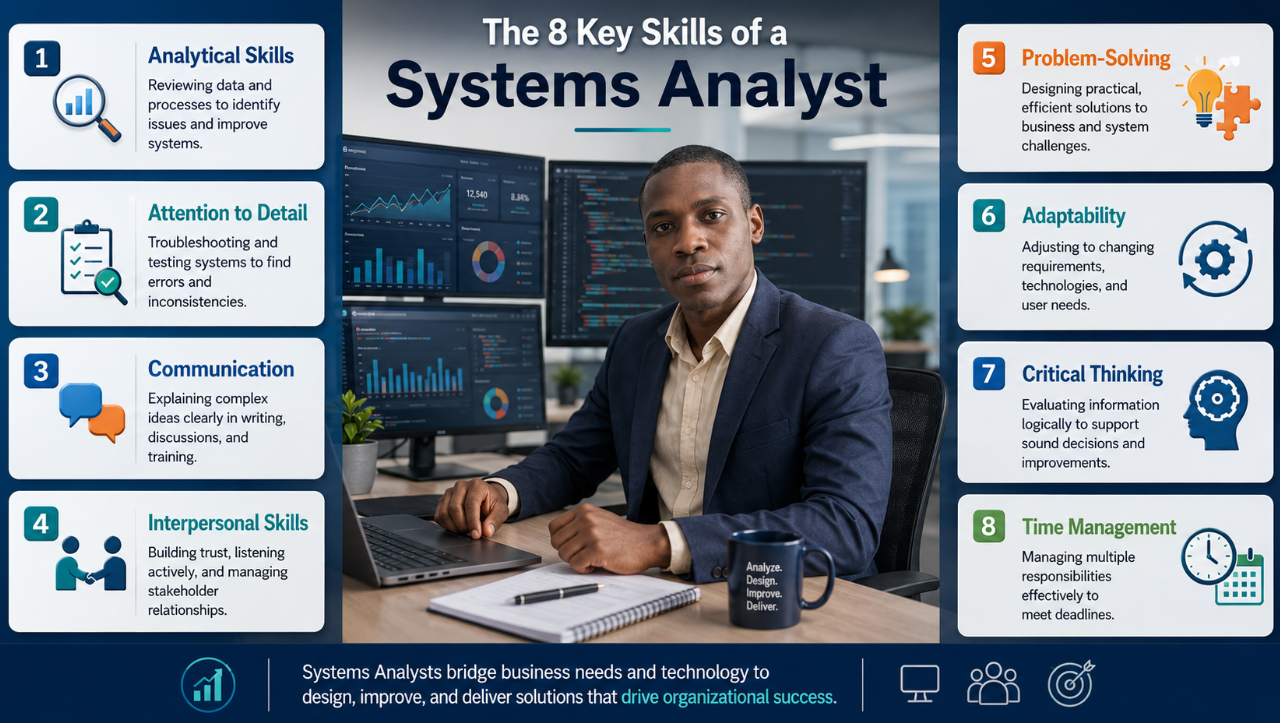
A Systems Analyst operates at the intersection of business processes, information technology, organizational behavior, data, and user experience. The analyst translates institutional needs into structured system requirements, evaluates existing processes, identifies inefficiencies, supports solution design, and ensures that digital systems are aligned with organizational objectives. This role requires more than technical knowledge. It demands analytical reasoning, critical judgment, communication competence, stakeholder engagement, adaptability, and strong professional discipline.
Effective systems analysis is central to the success of digital transformation initiatives. Many system failures do not occur because of poor programming alone, but because of unclear requirements, weak stakeholder involvement, inadequate process analysis, poor documentation, and insufficient understanding of organizational context. Therefore, the competencies of a Systems Analyst directly influence the quality, usability, sustainability, and impact of information systems.
This article examines the key skills required of a competent Systems Analyst and explains how these skills contribute to successful system development and organizational transformation.
Analytical Skills
Analytical skills form the intellectual foundation of systems analysis. A Systems Analyst must be able to examine complex organizational processes, interpret data, evaluate existing systems, and identify underlying problems that may not be immediately visible to users or management.
In practice, organizations often experience challenges such as duplicated workflows, fragmented data, manual reporting, delayed approvals, inconsistent records, and poor integration between systems. The role of the Systems Analyst is to investigate these issues systematically and determine their root causes. This requires the ability to collect information, analyze patterns, compare current processes with desired outcomes, and develop evidence-based recommendations.
Analytical skills enable the Systems Analyst to move beyond surface-level symptoms and understand the structural causes of system inefficiency. For example, a user may complain that a system is slow, but the actual cause may be poor database design, unnecessary workflow steps, weak server configuration, or unclear business rules. Without strong analytical thinking, the organization may address the wrong problem and invest in ineffective solutions.
A highly competent Systems Analyst uses analytical skills to:
Understand business processes and system behavior.
Identify inefficiencies, risks, and process gaps.
Interpret data and operational evidence.
Transform business problems into system requirements.
Recommend solutions that are realistic, measurable, and aligned with institutional goals.
In this sense, analytical skills allow the Systems Analyst to convert organizational complexity into structured knowledge that can guide system design and implementation.
Attention to Detail
Attention to detail is a critical professional attribute in systems analysis because information systems are highly dependent on accuracy, consistency, and logical coherence. A minor error in a requirement, data field, validation rule, user permission, workflow status, or report formula can produce serious operational consequences.
Systems Analysts are frequently involved in reviewing requirements, preparing documentation, validating system behavior, supporting user acceptance testing, and confirming whether the developed system reflects approved business rules. These activities require careful observation and disciplined review. Inaccurate documentation or overlooked system behavior may result in incorrect implementation, poor user experience, data integrity problems, or audit weaknesses.
For instance, in an approval workflow, a small mistake in role assignment may allow unauthorized users to approve sensitive transactions. Similarly, an incorrect status label may confuse users and affect reporting accuracy. These examples show that attention to detail is not a minor administrative quality; it is a fundamental control mechanism in system development.
Attention to detail helps the Systems Analyst to:
Detect errors during system testing.
Identify inconsistencies between requirements and implementation.
Ensure accuracy in system forms, reports, workflows, and permissions.
Improve the quality of technical and functional documentation.
Reduce operational, security, and compliance risks.
Communication Skills
Communication is one of the most important competencies of a Systems Analyst because system development involves multiple stakeholders with different levels of technical understanding. These stakeholders may include system users, managers, developers, database administrators, executives, quality assurance teams, vendors, and external partners.
The Systems Analyst must be able to translate business needs into technical requirements and technical constraints into understandable business language. This translation function is essential because users may not know how to express their needs in system terms, while developers may require precise specifications to implement the solution correctly.
Strong communication skills are required during requirements elicitation, stakeholder interviews, system demonstrations, user training, progress reporting, and documentation. The analyst must ask clear questions, listen actively, clarify assumptions, manage expectations, and present findings in a structured manner.
A Systems Analyst with weak communication skills may produce vague requirements, causing developers to interpret user needs incorrectly. Conversely, clear communication reduces ambiguity, improves collaboration, and increases the probability that the final system will meet user expectations. In advanced systems analysis, communication is not simply the ability to speak or write well. It is the ability to create shared understanding among stakeholders who think differently, speak differently, and prioritize different outcomes.
Communication skills are particularly important in preparing:
System Requirement Specifications.
Functional and non-functional requirements.
Business process documentation.
Use case descriptions.
User manuals and training guides.
Testing reports and issue logs.
Management briefs and technical reports.
Interpersonal Skills
Although systems analysis is often associated with technology, it is fundamentally a socio-technical discipline. Information systems operate within organizations, and organizations are made up of people, structures, cultures, rules, and power relationships. Therefore, interpersonal skills are essential for understanding user needs and managing stakeholder relationships.
A Systems Analyst must interact with users who may be frustrated by existing systems, resistant to change, uncertain about new technologies, or unable to clearly articulate their requirements. The analyst must demonstrate patience, empathy, professionalism, and active listening. These qualities help build trust and encourage stakeholders to provide honest and useful feedback.
Interpersonal skills are also important when managing conflicting requirements. Different departments may have different priorities, and users may request features that are technically difficult, costly, or inconsistent with organizational policy. The Systems Analyst must balance these expectations while maintaining professional objectivity. A technically correct system may still fail if users do not accept it. Therefore, interpersonal competence supports not only requirements gathering, but also system adoption, organizational learning, and long-term sustainability.
Strong interpersonal skills help the Systems Analyst to:
Build trust with users and stakeholders.
Encourage participation during requirements gathering.
Manage disagreements constructively.
Understand user behavior, expectations, and frustrations.
Support user acceptance testing and change management.
Promote ownership and adoption of the system.
Adaptability
Adaptability is a vital skill in modern systems analysis because technology, regulations, business priorities, and user expectations change continuously. A Systems Analyst must be capable of responding to these changes without compromising the overall integrity of the system.
During system development, requirements may evolve due to new institutional directives, legal changes, budget constraints, integration requirements, stakeholder feedback, or emerging technologies. In such situations, the Systems Analyst must assess the impact of change, update documentation, communicate implications, and guide the project team toward practical adjustments.
Adaptability does not mean accepting every change without analysis. Rather, it means responding intelligently to change while protecting the project from unnecessary complexity, scope creep, and design instability.
In digital transformation projects, change is inevitable. A Systems Analyst who lacks adaptability may become rigid and ineffective. However, an adaptable analyst can help the organization remain responsive, innovative, and resilient.
An adaptable Systems Analyst is able to:
Adjust system requirements when business needs change.
Respond to new stakeholder priorities.
Support system upgrades and enhancements.
Reassess workflows when organizational processes are modified.
Work effectively in uncertain or evolving project environments.
Maintain project direction despite changing circumstances.
Critical Thinking
Critical thinking enables a Systems Analyst to evaluate information logically, question assumptions, compare alternatives, and make sound professional judgments. This skill is especially important because user requests are not always equivalent to real system requirements.
In many cases, users describe what they want based on current frustrations or familiar manual processes. However, implementing user requests exactly as stated may reproduce existing inefficiencies in digital form. The Systems Analyst must therefore examine the deeper need behind the request and determine whether there is a better, simpler, or more sustainable solution.
Through critical thinking, the Systems Analyst prevents poor design decisions, reduces unnecessary complexity, and supports rational decision-making. This competency is particularly important in large systems where one decision can affect workflows, reports, integrations, user permissions, and institutional accountability.
A Systems Analyst with strong critical thinking skills does not simply document what users say. They evaluate, refine, validate, and transform user needs into solutions that are logically sound and organizationally valuable.
Critical thinking allows the analyst to ask fundamental questions such as:
What problem is the organization actually trying to solve?
Is this requirement necessary or merely desirable?
What risks are associated with this solution?
How will this feature affect other modules?
Does the proposed design support future scalability?
Are there policy, security, or data governance implications?
Is there a more efficient way to achieve the same objective?
Technical Skills
Technical competence is essential for a Systems Analyst because the role requires a practical understanding of how information systems are designed, developed, integrated, tested, deployed, and maintained. While a Systems Analyst may not always be responsible for writing production code, they must understand enough technology to communicate effectively with developers and evaluate whether proposed solutions are feasible.
Technical skills allow the analyst to bridge the gap between business requirements and system implementation. Without technical understanding, the analyst may prepare requirements that are unclear, unrealistic, insecure, or difficult to implement. Technical knowledge strengthens the analyst’s ability to review system designs, support developers, identify implementation risks, and participate meaningfully in technical discussions. It also improves the quality of system documentation because requirements can be written in a way that is understandable, testable, and technically actionable.
In modern organizations, the Systems Analyst must understand not only what the system should do, but also how the system can be structured to operate securely, efficiently, and sustainably.
Important technical areas for a Systems Analyst include:
Software development life cycle.
Database concepts and data modeling.
System architecture.
API and system integration.
Workflow and business process modeling.
User interface and user experience principles.
Cybersecurity and access control.
Reporting, dashboards, and analytics.
Testing and quality assurance.
Basic programming logic.
Cloud, hosting, and deployment concepts.
Time Management
Time management is a professional discipline that enables Systems Analysts to handle multiple responsibilities within limited project timelines. Systems analysis involves meetings, research, documentation, validation, testing, reporting, user support, issue tracking, and coordination with technical teams. These activities often occur simultaneously and require careful prioritization.
Poor time management can delay requirements approval, system development, testing, training, and deployment. In complex projects, delays in analysis can affect the entire implementation schedule because developers, testers, managers, and users depend on timely outputs from the analyst. Time management is not only about personal efficiency. It is also about protecting project momentum, supporting accountability, and ensuring that system development activities remain coordinated.
A disciplined Systems Analyst understands that high-quality analysis must be delivered within practical timelines. Excellence in systems analysis therefore requires both intellectual rigor and professional execution.
Effective time management enables the Systems Analyst to:
Prioritize tasks based on project importance and urgency.
Prepare documentation within agreed timelines.
Schedule and conduct stakeholder consultations efficiently.
Track issues and follow up on pending decisions.
Support testing without delaying development cycles.
Provide timely updates to management and project teams.
Maintain productivity across multiple projects or modules.
The Strategic Value of Systems Analyst Skills
The skills discussed above should not be viewed as isolated personal qualities. Together, they form a professional competency framework that enables the Systems Analyst to support organizational transformation.
Analytical skills help the analyst understand problems. Attention to detail ensures accuracy. Communication and interpersonal skills support stakeholder engagement. Adaptability enables responsiveness to change. Critical thinking strengthens decision-making. Technical skills support feasibility and implementation. Time management ensures that all these activities are delivered within project constraints.
When these skills are combined, the Systems Analyst becomes a strategic contributor to digital transformation. The analyst helps organizations move from fragmented processes to integrated systems, from manual reporting to data-driven decision-making, from unclear workflows to standardized procedures, and from reactive problem-solving to structured institutional improvement.
In this regard, the Systems Analyst is not merely a participant in system development. The analyst is a knowledge integrator, process evaluator, requirements engineer, solution designer, quality advocate, and transformation facilitator.
Conclusion
The role of a Systems Analyst is increasingly important in organizations that seek to improve service delivery, strengthen operational efficiency, enhance information governance, and achieve sustainable digital transformation. Successful information systems require more than software development. They require deep understanding of institutional needs, accurate requirements, effective stakeholder collaboration, strong technical judgment, and continuous alignment between technology and organizational objectives.
A highly competent Systems Analyst combines analytical reasoning, attention to detail, communication, interpersonal competence, adaptability, critical thinking, technical knowledge, and time management. These skills enable the analyst to transform complex organizational problems into structured, reliable, and user-centered digital solutions.
In an era where institutions depend on digital systems for planning, service delivery, monitoring, reporting, accountability, and decision-making, the Systems Analyst plays a decisive role in ensuring that technology produces real organizational value.
Therefore, developing strong Systems Analyst skills is not only a professional requirement; it is a strategic necessity for any organization committed to effective digital transformation, institutional performance, and long-term technological sustainability.
Browse all posts on the updates page or return to the homepage.